
Oropharyngeal airway use in paediatric patients
Oropharyngeal airways (OPAs) are useful in maintaining airway patency in unconscious patients of all ages. OPAs are often referred to as a Guedel's airways, after the American physician who developed them. These devices are useful adjuncts in unconscious patients but do carry risks if not sized or inserted correctly. OPAs prevent the relaxed tongue and surrounding soft tissues from falling backwards and obstructing the pharynx.
Children have relatively large tongues, narrow upper airways and soft, easily displaced airway structures. Even minor obstruction can significantly increase the work of breathing or interfere with effective bag-mask ventilation. An OPA can help maintain airway patency, but they don't protect the child from aspiration and don't replace the need for appropriate positioning, suction, or ongoing assessment of airway patency.
An OPA may be considered when a child:
- is unconscious or unresponsive to painful stimuli
- has no effective gag or cough reflex
- has an upper-airway obstruction caused by the tongue or soft structures of the pharynx
- requires bag-mask ventilation (and is unconscious/has no gag or cough reflex)
- remains difficult to ventilate despite appropriate positioning and airway manoeuvres
An OPA should not be inserted into a conscious or semiconscious child with an intact gag reflex. Stimulation of the posterior pharynx may cause coughing, gagging, vomiting, aspiration, laryngospasm or further airway compromise. Removal of the OPA should occur immediately if the child begins to gag, cough, retch, or regains consciousness.
Tips for insertion
- Open the airway with basic manoeuvres (use jaw thrust if spinal injury concerns, head tilt chin lift for a child, neutral position for an infant - avoid hyperextension as this obstructs the airway, use a small towel under the shoulders to help achieve a neutral position in an infant).
- Clear the airway with gentle suction - avoid prolonged suctioning as this can cause bradycardia in children. Do not perform finger sweeps as these can force a foreign body further down the airway and completely occlude at the level of the cricoid ring.
- Check for loose teeth, especially in school aged children, as these can become dislodged and occlude the airway.
Choose the correct size
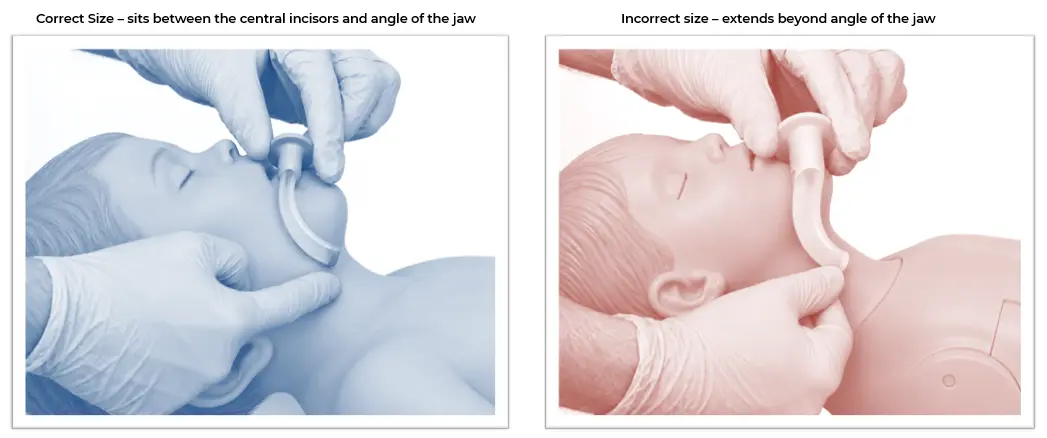
OPA size must be selected according to the child's anatomy rather than age alone. Please the airway beside the child's face and measure from the middle of the gumline or central incisors to the angle of the jaw. When positioned against the face, the flange should align with the lips, and the tip should reach approximately to the angle of the jaw. OPA colour coding can assist with identifying devices, but colours and labelled sizes may vary between manufacturers. Always confirm the size anatomically before insertion.
An OPA that is too small may:
- push the tongue further backwards
- worsen the airway obstruction
- fail to maintain airway patency
- become displaced within the mouth
An OPA that is too large may:
- cause oral or pharyngeal trauma
- press on the epiglottis or laryngeal structures
- provoke gagging, vomiting or laryngospasm
- worsen airway obstruction
Insertion technique
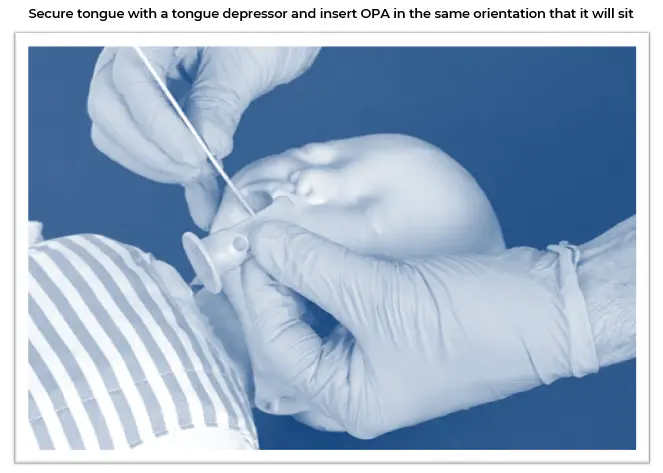
In infants and young children, the airway should be inserted under direct vision with the cure following the natural contour of the tongue. The adult technique of inserting the airway upside down and rotating it through 180 degrees should be avoided in small children because it may injure the soft palate.
- Select the measured OPA and have oxygen, suction, bag-mask equipment and alternative airway sizes or devices immediately available.
- Confirm the child doesn't have an effective gag reflex.
- Position the child into neutral (infant) or head-tilt lift (child) unless cervical spine precautions are in place.
- Use a gentle scissor technique to open the mouth, inspect the airway for secretions, vomit, blood, loose teeth or visible foreign material. Suction if required. Do not perform blind finger sweep.
- Depress or move the tongue forwards with an appropriately sized tongue depressor or laryngoscope blade.
- Introduce the OPA with its concavity facing downwards following the curve of the tongue. Advance gently until the flange rests at the lips or teeth. Do not force the airway
- Confirm that airflow and ventilation have improved.
Ongoing care
An OPA is a temporary airway adjunct, its presence doesn't guarantee a patent airway or protect against aspiration. While it remains in place, maintain appropriate head and jaw position, suction secretions as required, monitor for signs of gagging, coughing, vomiting or deterioration. Remove the OPA when the child develops airway reflexes. Removal is performed by gently withdrawing the device along its natural curve, rotation is unnecessary.
An OPA can rapidly improve ventilation when a child's tongue is obstructing the airway, but success depends on three things: selecting the correct size, inserting the device without causing trauma, and reassessing regularly. As one component of airway management, the skill to insert an OPA correctly is an important part of resuscitation and paediatric emergency management. If you are interested in updating your knowledge and confidence in paediatric airway management, you may be interested in attending our Paediatric Advanced Life Support courses These workshops utilise a simulation based approach and are based upon the current Australian Resuscitation Council guidelines.
For a full list of events and courses please visit https://medcast.com.au/courses.
References:
Australian and New Zealand Council on Resuscitation (ANZCOR) ANZCOR Guideline 12.2 – Introduction to Paediatric Advanced Life Support Techniques in Paediatric Advanced Life Support.
Hambrecht, K. (2019). Cardiopulmonary resuscitation: basic and advanced life support. Chapter 70 in Brown, D., Edwards, H., Buckley, T., and Aitken, R.L. (eds.). Lewis’s Medical-Surgical Nursing: Assessment and Management of Clinical Problems. (5th ed). Elsevier: Chatswood.
Royal Children’s Hospital Melbourne (RCH), The Paediatric Trauma Manual: Airway Procedures.
Content updated 2026

Susan is the Head of Nursing Education for the Medcast Group.
DipAppScNsg, BN, CritCareCert, CoronaryCareCert, TraumaNsgCareCert, CertIV(TAE), MN(Ed), and GradCert(Ldrshp & Mgt).
Become a member and get unlimited access to 100s of hours of premium education.
Learn moreTrack-and-trigger scores have reshaped how we recognise deterioration — but the score only tells us when to look, not what we're seeing. Physiological reserve, masked deterioration, and cognitive bias, all remind us that clinical judgement remains our sharpest tool for reading the patient behind the number.
Mervyn, is day 2 following surgical repair for a fractured neck of femur. He has mild dementia, lives at home with family support and is normally chatty, interactive and knows his family when they visit.
Follow James, a 7-year-old boy scheduled for a tonsillectomy and adenoidectomy, as we explore how the 4 P’s of child preparation – Prepare, Play, Parent, Praise – can be used in day surgery to reduce procedural anxiety, support family-centred care, and improve the overall patient experience