
Early signs of confusion? Look again
At morning handover, the night staff report Merv is settled, with no issues. During your shift, his obs have been stable but you notice he dozed through lunch, was lethargic and wasn’t sure who his family were when they visited him.
Is Merv’s dementia getting worse?
Merv has the signs of hypoactive delirium – quiet, drowsy, inattentive, with an acute change from baseline. This behaviour change may be overlooked because he isn’t disruptive, his obs are normal, but this new inattention is less likely to be related to his dementia and more likely to be an indication of clinical deterioration.
Delirium superimposed on dementia is the trap. Dementia is the single biggest risk factor for delirium, so the two frequently coexist. A person with known dementia who becomes acutely more confused, drowsy, or agitated is, until proven otherwise, experiencing delirium. There are some common causes of delirium that can be remembered easily:
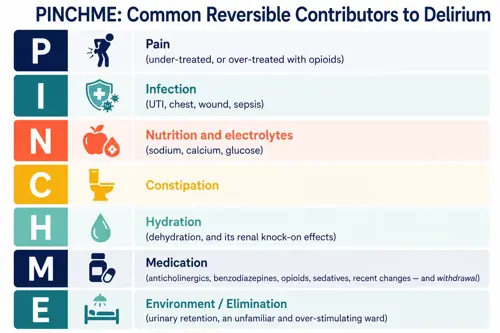
Why delirium belongs in a conversation about deterioration
Delirium is an acute, usually reversible disturbance of attention, awareness and cognition that develops over hours to days and fluctuates across the day.[1,4] It is one of the most common serious complications of hospitalisation in older adults, yet it remains one of the most frequently missed. Australian and international data put the prevalence in older inpatients somewhere between 11% and 42%, but clinicians recognise only around 12–35% of those cases at the bedside.[9] Undetected delirium may be as high as 60% in some settings.[10]
The most important reframe is this: delirium is rarely just confusion — it is a barometer of acute physiological deterioration. New or fluctuating confusion is often the earliest, and sometimes the only, sign of sepsis, hypoxia, hypoglycaemia, urinary retention, medication toxicity or an evolving metabolic disturbance.[1,4] That is precisely why cognitive change sits inside the national system for recognising and responding to acute deterioration, and why the "C" in the ACVPU scale (Alert, Confusion, Voice, Pain, Unresponsive) should trigger clinical review, not reassurance.[2] Missing delirium is, in effect, missing a deteriorating patient.
Delirium also carries real consequences. It is independently associated with longer length of stay, increased falls, pressure injuries, functional decline, new nursing-home placement, and higher in-hospital and post-discharge mortality.[1,4] It is a recognised hospital-acquired complication, recorded at 35.7 per 10,000 admissions in Australia in 2019–20 — a figure widely accepted to understate the true burden because so much delirium goes undocumented.[3]
The five core features of delirium
A disturbance of attention and awareness — reduced ability to direct, focus, sustain and shift attention.
Acute onset and a fluctuating course — a change from the person's baseline, developing over hours to days and typically waxing and waning in severity, often worse in the late afternoon and overnight ("sundowning").
An additional cognitive disturbance — for example disorientation, memory deficit, language or perceptual disturbance.
Not better explained by another neurocognitive disorder and not occurring in a severely reduced level of arousal such as coma.
Evidence that it is a physiological consequence of a medical condition, substance intoxication or withdrawal, a medication, or multiple causes.
Inattention is the clinical hallmark. If a patient cannot hold a simple attentional task — reciting the months of the year backwards, for instance — delirium should be high on your list.
Motor subtypes — and why the quiet ones are dangerous
Delirium presents in three motor subtypes, and recognising all three is a core nursing skill: [8,11]
Hyperactive: agitation, restlessness, wandering, hypervigilance, sometimes hallucinations or aggression. The easiest to spot because it disrupts the ward.
Hypoactive: drowsiness, withdrawal, slowed responses, reduced movement and speech, apathy. Frequently mistaken for tiredness, depression, "settling," or simply being a "good, quiet patient."
Mixed: features of both, fluctuating within the same day.
Hypoactive delirium is the more common subtype in older inpatients and the more dangerous, precisely because it is quiet. It is under-recognised, diagnosed later, and associated with worse outcomes than the hyperactive form.[8,11]
The practical lesson for acute care: the settled, sleepy patient in the corner bed warrants the same cognitive vigilance as the agitated one.
Who to screen, and when
A structured, routine approach demonstrably improves detection.[1] The standard directs that risk be assessed in the pre-admission clinic or within 24 hours of presentation, and that cognitive function be screened for anyone at risk.[1,6] Screen:[2,6]
Everyone aged 65 and over (and Aboriginal and Torres Strait Islander patients from 45, reflecting the earlier age profile of risk);
Any patient at risk of delirium regardless of age — key risk factors include existing cognitive impairment or dementia, severe or deteriorating medical illness, current hip fracture, and advanced age; and
Any time a patient, carer, family member or staff member raises a concern about a change in cognition or behaviour.
A positive screen is not a diagnosis, it is a prompt for further clinical assessment, early intervention and early family involvement.
Learn more including assessment tools, finding and treating the cause and the latest recommendations for management at https://medcast.com.au/courses/1320
References
Australian Commission on Safety and Quality in Health Care. Delirium Clinical Care Standard. Sydney: ACSQHC; 2021 (first released 2016, revised 2021).
Australian Commission on Safety and Quality in Health Care. National Safety and Quality Health Service (NSQHS) Standards, 2nd ed. — Comprehensive Care Standard (Standard 5), Actions 5.29 and 5.30; and Recognising and Responding to Acute Deterioration (Standard 8), Action 8.5. Sydney: ACSQHC; 2021.
Australian Commission on Safety and Quality in Health Care. Hospital-acquired complication — Delirium. Sydney: ACSQHC.
American Psychiatric Association. Diagnostic and Statistical Manual of Mental Disorders, 5th ed., Text Revision (DSM-5-TR). Washington, DC: APA; 2022.
National Institute for Health and Care Excellence. Delirium: prevention, diagnosis and management in hospital and long-term care (CG103). London: NICE; 2010 (updated).
Australian Commission on Safety and Quality in Health Care. Information for clinicians — Delirium Clinical Care Standard. Sydney: ACSQHC; 2021.
Australian Commission on Safety and Quality in Health Care. Delirium Clinical Care Standard — Quality statements. Sydney: ACSQHC; 2021.
Bail K, et al. Australian Delirium Clinical Care Standard: not just another brick in the wall. Age and Ageing. 2023;52(6):afad078.
Clinical Excellence Queensland. Diagnosis: Delirium. Queensland Health (prevalence and recognition rates in hospitalised older inpatients).
Hshieh TT, et al. Effectiveness of multicomponent nonpharmacological delirium interventions: a meta-analysis. JAMA Intern Med. 2015;175(4):512–520.
Confusion Assessment Method (CAM) and variants (CAM-ICU, 3D-CAM); Nursing Delirium Screening Scale (Nu-DESC). See also StatPearls, Differentiating Delirium Versus Dementia in Older Adults, NCBI Bookshelf; 2026.
4AT screening for delirium (development and validation): Bellelli G, et al. Age and Ageing. 2014, NIHR/NCBI.
4AT screening for delirium in dementia: meta-analysis of diagnostic performance. PMC; 2025.
StatPearls. Differentiating Delirium Versus Dementia in Older Adults. NCBI Bookshelf; 2026.
Inouye SK, et al. Hospital Elder Life Program (HELP) and multicomponent prevention; Hshieh TT, et al.

Susan is the Head of Nursing Education for the Medcast Group.
DipAppScNsg, BN, CritCareCert, CoronaryCareCert, TraumaNsgCareCert, CertIV(TAE), MN(Ed), and GradCert(Ldrshp & Mgt).
Become a member and get unlimited access to 100s of hours of premium education.
Learn moreAn oropharyngeal airway can relieve upper airway obstructions in an unconscious child without an intact gag reflex. Select size from incisors/centre of the mouth to the angle of the jaw, insert the correct way up under direct vision using a tongue depressor. Incorrect sizing or insertion may worsen obstruction or cause trauma, gagging, vomiting and aspiration risk.
Track-and-trigger scores have reshaped how we recognise deterioration — but the score only tells us when to look, not what we're seeing. Physiological reserve, masked deterioration, and cognitive bias, all remind us that clinical judgement remains our sharpest tool for reading the patient behind the number.
Jose is a 9 year unvaccinated child with a 5 day history of a low grade fever, cough and sore throat...