

Perimenopause - clinical fact sheet and MCQ

Overview
Perimenopause is the transitional phase leading up to and including menopause, during which a woman’s ovaries gradually produce less estrogen. It is defined as the time from onset of cycle irregularity to 12 months after the final period.
Perimenopause is characterised by fluctuations in ovarian function and hormone levels. During this time, a woman may experience a range of physical and psychological symptoms.
Menopause refers to the final menstrual period. It is a retrospective diagnosis made after 12 months of amenorrhoea.
Stages of Menopause
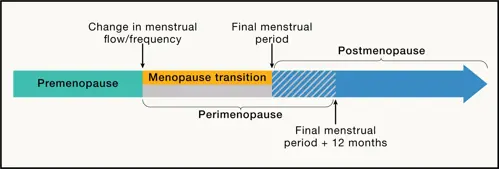
Image reference Menopause—Biology, consequences, supportive care, and therapeutic options: Cell
Epidemiology
In Australia:
the average age of menopause is 51 years, and most reach menopause between 45 to 55 years
up to 10% of women experience early menopause (<45 years)
about 1% of women experience premature ovarian insufficiency (POI) (before age 40)
Clinical features of peri/menopause
Menopausal symptoms affect around 75% of women and are moderate to severe in 28%. They may begin during perimenopause and last 7-10 years on average.
Typical symptoms include:
vasomotor symptoms (VMS) (hot flushes, night sweats)
urogenital symptoms (vaginal dryness, irritation, dyspareunia, urinary urgency)
psychological symptoms (mood disturbance, anxiety, irritability)
sleep disturbance
decreased libido
cognitive symptoms
The AMS symptom score card can be used to document symptoms and monitor response to treatments.
Investigations
Perimenopause is usually diagnosed clinically on the basis of new onset vasomotor or other symptoms and a change in the pattern of menstrual bleeding.
Consider investigations if:
aged <45 with symptoms (FSH, oestradiol on two occasions, four weeks apart)
differential diagnosis is uncertain (TSH, Hb, ferritin, blood glucose)
Initial management
Educate about the normal menopausal transition
Discuss expectations, quality of life, and treatment goals
Encourage lifestyle modification: smoking cessation, reduced alcohol intake, healthy weight, regular exercise
Pharmacological treatment
Menopausal hormone therapy (MHT)
MHT is the most effective treatment for vasomotor symptoms and urogenital atrophy. It may improve sleep, mood, and joint pain in some women.
MHT can also improve bone density and reduce fracture risk and is associated with a reduction in the risk of heart disease and type 2 diabetes in some women.
Indications:
management of menopausal symptoms, including vasomotor and genitourinary symptoms , sleep disturbance
prevention/management of low bone density and osteoporosis
treatment of POI (continue until at least age 50)
MHT is also generally recommended for women aged 40-45 years with early menopause
Contraindications to systemic MHT:
history of hormone-sensitive cancer (eg, breast, endometrial)
unexplained vaginal bleeding
active VTE disease/thrombophilia
untreated/uncontrolled cardiovascular disease
severe active liver disease
Formulations and route
This clinical guide outlines MHT prescribing principles.
Combined MHT (estrogen + progestogen): for women with an intact uterus to reduce endometrial hyperplasia risk
Estrogen-only MHT: for women post-hysterectomy (unless history of moderate to severe endometriosis)
Estrogen can be delivered orally or transdermally (patch, gel)
Transdermal is preferred for women at higher risk of thromboembolic events or with metabolic/liver disorders
Patients with history of migraine may also benefit from transdermal delivery as it maintains a more stable supply of estrogen, avoiding the fluctuating serum oestradiol levels, which can be a migraine trigger in the perimenopausal years
Progesterone can be delivered either via an intrauterine device (Mirena), orally, or as a transdermal patch
Perimenopausal women experiencing intermittent menses or those very recently postmenopausal benefit from cyclical oral progesterone (14 days on, 14 days off) to prevent breakthrough bleeding
For women who are postmenopausal, continuous progesterone is appropriate
Breakthrough bleeding may occur in the first three to six months of any MHT regimen, but any unscheduled bleeding after that should be investigated
It is important to advise women that MHT does not provide contraception due to the lower doses of estrogen and progesterone (the exception would be women who are using a Mirena device for endometrial protection)
For women <50 who are still having periods, a low-dose combined oral contraceptive pill (COCP) may be an appropriate option to both manage their symptoms and provide adequate contraceptive cover
See the AMS Guide to MHT/HRT Doses - Australia | Information Sheet | Australasian Menopause Society Hub for a list of MHT products available in Australia.
Dosing principles
Start low and titrate to symptom relief
No standard duration; use the lowest effective dose for the shortest period consistent with treatment goals
Annual review is essential to reassess risks, benefits, and treatment goals
Breast cancer and thromboembolism risk
Combined MHT is associated with a very small increase in breast cancer risk, increasing with age at initiation and duration of use
Estrogen-only MHT may have a lower breast cancer risk compared to combined MHT
Oral MHT carries a higher risk of thromboembolism; transdermal preferred in higher-risk women
For most women, the benefits of MHT outweigh the risks, with the lowest risk when started before the age of 60, or within 10 years of menopause; annual review should occur to determine need for ongoing use
Monitoring
Once treatment has been established, annual review is recommended to establish the indications and ongoing need for treatment along with individual risks and benefits. This should include:
review of efficacy and tolerability
review of blood pressure, BMI, and other CV risk factors
mammography and cervical screening per national screening guidelines
a trial of lower dose MHT or cessation can occur if the need for treatment is uncertain
There is no specific recommended duration for MHT. Continuation should be based on consideration of benefits and harms at each yearly review.
Special considerations
Women with early or surgical menopause are generally advised to take MHT until at least the age of 50 years for symptom control and long-term health protection
Testosterone transdermal cream is commonly promoted as an option to improve mood or energy levels; however, the only evidence-based indication is for the treatment of hypoactive sexual desire dysfunction (HSDD) in postmenopausal women
Management of genitourinary syndrome of menopause (GSM)
Vaginal estrogen therapy effectively treats GSM (vaginal dryness, dyspareunia, urinary frequency and urgency, and recurrent UTIs) but does not treat vasomotor symptoms
Vaginal estrogen can be used alongside systemic MHT when GSM persists despite systemic treatment
Vaginal estrogen is considered safe for most women, including those with a history of breast cancer (in consultation with oncology)
Prasterone (vaginal DHEA) has weak estrogenic and androgenic effects; there are no head-to-head trials with vaginal estrogen and safety data in women with a history of breast cancer is limited
Non-hormonal vaginal moisturisers and lubricants are useful for vaginal dryness
Non-hormonal treatments for vasomotor symptoms
Fezolinetant:
neurokinin-3 receptor antagonist
modulates thermoregulatory pathways in the hypothalamus
TGA-listed for moderate to severe VMS
requires LFT monitoring monthly for the first 3 months, then at 6 and 9 months
Other non-hormonal medications include SSRIs/SNRIs (eg venlafaxine, paroxetine), gabapentin, pregabalin, and oxybutynin; there is limited evidence to support their use for VMS and use is off-label
Complementary and lifestyle therapies
Cognitive behavioural therapy can help both menopausal symptoms and mood
Yoga and hypnosis show benefit in small trials
Limited evidence for herbal remedies (see AMS factsheet)
Indications for specialist referral
Diagnostic uncertainty (eg atypical presentation, persistent symptoms)
Suspected POI or early menopause
Failure of primary care management
History of hormone-sensitive cancer or complex medical background
References
The Royal Australian and New Zealand College of Obstetricians and Gynaecologists. Managing menopausal symptoms. 2020. Available at: https://ranzcog.edu.au/wp-content/uploads/Managing-Menopausal-Symptoms.pdf. (last accessed June 2025).
Australasian Menopause Society. Non-hormonal Treatments for Menopausal Symptoms. 2024. Available at: https://www.menopause.org.au/images/stories/infosheets/docs/AMS_Nonhormonal_Treatments_for_Menopausal_Symptoms.pdf. (last accessed June 2025).
S. R. Davis, S. Taylor, C. Hemachandra, K. Magraith, P. R. Ebeling, F. Jane &
R. M. Islam (2023) The 2023 Practitioner’s Toolkit for Managing Menopause. Climacteric.2023; 26(6):517-536.
Therapeutic Guidelines. Overview of menopause. Therapeutic Guidelines. 2025. Available from: https://app-tg-org-au.ap1.proxy.openathens.net. (last accessed Jul 2026).
Claim your CPD
After reading the clinical summary above and reviewing the references, complete the quiz to gain 30 minutes of EA CPD and 30 minutes of RP CPD. You can either self-report CPD to your CPD home, or Medcast will track your learning via your personal CPD Tracker and you can download and report these points once a year. See our CPD Tracker FAQ.
Quiz
Please log in or sign up for a free Medcast account to access the case study questions and achieve the CPD credits.

The Quality Use of Medicines Alliance is a unique consortium of health sector organisations representing quality use of medicines expertise, education providers, researchers, colleges, peak bodies, member-based organisations, and consumer groups. Funded by the Australian Government under the Quality Use of Diagnostics, Therapeutics and Pathology (QUDTP) Program.
Dr Nazha Nazeem

Medical impairment assessment forms are where DVA compensation assessments most often come unstuck. We walk through nine common pitfalls, showing where each one occurs on the forms, how to avoid it, and worked examples from a sample case.
Dr Rebecca Chan

GPs play a central role in cancer survivorship care. This practical guide explores coordinated shared care, recurrence monitoring, long-term and late treatment effects, chronic disease management, psychological wellbeing, preventive health and clear pathways for specialist referral.
Dr Rebecca Chan
Learn how GPs can provide culturally safe, inclusive cancer survivorship care for Aboriginal and Torres Strait Islander, rural and remote, LGBTIQA+, and culturally and linguistically diverse patients. Explore practical strategies to reduce barriers, improve engagement and support equitable outcomes.