
Supporting Australian veterans through allied health: a guide to DVA-funded care
Australian veterans live with higher rates of chronic disease, musculoskeletal injury, chronic pain, and mental health conditions than the general population. Allied health professionals play a central role in supporting their functional recovery, mental wellbeing, and quality of life – and the Department of Veterans’ Affairs (DVA) funds these services so eligible veterans can access them without out-of-pocket cost when providers accept DVA Veteran Card arrangements.
This guide outlines what allied health providers need to know to deliver compliant, coordinated, veteran-centred care under DVA arrangements.
Veteran eligibility and card types
Accurate identification of the veteran’s card type at the outset helps ensure appropriate service provision and avoids compliance issues.
A Gold Card: covers all clinically required allied health services and Rehabilitation Appliances Program (RAP) items
A White Card: covers treatment for accepted service-related conditions and any non-liability conditions
Non-Liability Health Care: allows White Card holders access to mental health services (eg psychology, mental health OT) without needing a connection to service, provided there is a referral and clear coordination with the GP
The Provisional Access to Medical Treatment (PAMT) program: provides interim funding for 20 common conditions after a claim has been submitted, to support care while a claim is assessed (exclusions apply); more details can be found here
Checking eligibility: confirm the card type and accepted conditions (for White Card holders) before treatment. Use the DVA eligibility tool for assistance, or contact DVA’s Health Provider Line on 1800 550 457 if clarification is needed
Health providers may not realise a veteran is eligible for allied health treatment because access isn’t always tied to an obvious physical injury, and some entitlements can sit alongside usual Medicare pathways. For example, a veteran with a White Card may still be able to access DVA-funded mental health-related allied health (such as psychology, social work or occupational therapy) under Non‑Liability Health Care, provided there’s an appropriate referral and coordination with their GP.
The allied health treatment cycle
Allied health arrangements are changing after 1 July 2027. More information will be available on the DVA website as details become available.
Introduced in October 2019, the allied health treatment cycle promotes goal-oriented, collaborative care. Key steps of the cycle include:
A GP, initial specialist, or hospital discharge planner issuing a referral to allied health professional, valid for up to 12 sessions or 12 months, whichever ends first
The allied health professional developing a patient care plan with the veteran, identifying measurable health goals
Delivery of treatment by the allied health professional
The allied health professional sending a report to the veteran’s usual GP at the end of the treatment cycle, outlining treatment, progress and recommendations
At the next patient visit, the GP will then review the report and issue a new referral if clinically necessary
Veterans may have multiple concurrent cycles across different disciplines. For example, a client can receive 12 physiotherapy treatments and 12 podiatry treatments simultaneously under two separate cycles. There is currently no limit on the number of clinically justified cycles.
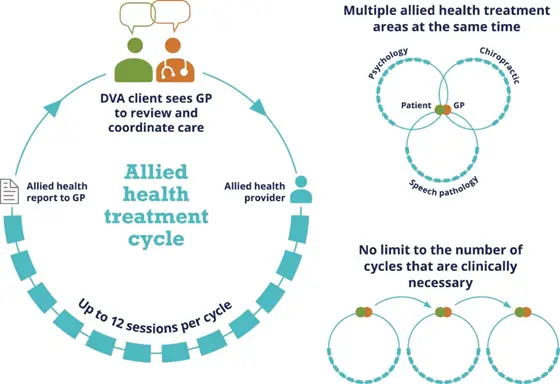
Figure 1: the allied health treatment cycle (source: https://www.dva.gov.au/what-we-help-with/health-support/allied-health/allied-health-treatment-cycle).
Service exceptions to the treatment cycle
The allied health treatment cycle does not apply to all services. Several allied health and related services operate under separate DVA funding and referral arrangements and are excluded from the standard 12-session or 12-month limits:
dental services
optical services
hearing services
counselling services with Open Arms – Veterans & Families Counselling
therapies that have their own specific treatment limits
Client exceptions to the treatment cycle
Allied health arrangements are changing after 1 July 2027. More information will be available on the DVA website as details become available.
Clients who hold a Totally and Permanently Incapacitated (TPI) Gold Card are exempt from the allied health treatment cycle for physiotherapy and exercise physiology services only. The treatment cycle applies for other allied health services (eg occupational therapy, podiatry)
TPI status is clearly identified by the letters ‘TPI’ printed on the front of the Gold Card. Note that not all Gold Card holders have TPI status.
These clients can access physiotherapy and exercise physiology under annual or indefinite referrals rather than the standard 12-session or 12-month cycle. Even though the session limits do not apply, best practice principles of treatment must still be followed including appropriate communication and review with the rest of the treating team.
At-risk clients
Clients who need additional care may be eligible for tailored arrangements. The At Risk Client Framework allows tailored referral arrangements for veterans with complex needs who may not be well served by the standard treatment cycle. As determined by the clients usual GP, both of the following criteria must be met:
the client experiences complex psychosocial factors, severe health conditions or needs, severe functional impairments, or a combination of these that would adversely affect their health, treatment or wellbeing under the standard treatment cycle
the client’s quality of care and health outcomes would be improved by tailored referral arrangements
Best practice principles of treatment must still be followed including appropriate communication and review with the rest of the treating team.
Billing as a DVA provider
Most allied health professionals are automatically registered with DVA upon holding a current Medicare provider number.
DVA reimburses allied health services according to published, discipline-specific schedules of fees
Providers must bill at the scheduled rate – no gap fees may be charged to veterans
Claims are submitted electronically through Services Australia
Always refer to the current schedule of fees and the relevant discipline-specific notes for allied health providers for item descriptors, claiming rules, and documentation requirements
More information for each discipline can be found here.
Practical tips for allied health professionals
Always confirm card type, TPI status, and accepted conditions before starting treatment
Ensure you have an appropriate GP referral
Document clinical justification clearly, especially for White Card clients
Send concise, timely reports to the GP at the end of each cycle
Check the DVA provider pages for the latest notes, fee schedules, and RAP resources to ensure you are billing DVA in line with the legislation
Adopt a veteran-centred approach: involve the veteran in goal setting and focus on functional outcomes and return to meaningful activity
Make sure the care you provide is clinically necessary and in line with good practice treatment
References
Department of Veterans' Affairs. Allied health treatment cycle. 2025. https://www.dva.gov.au/providers/information-dental-psychology-allied-health-providers/allied-health-treatment-cycle. (last accessed May 2026).
Department of Veterans' Affairs. Allied health treatment cycle guide [PDF]. 2025. https://www.dva.gov.au/sites/default/files/2025-08/allied-health-treament-cycle-guide.pdf. (last accessed May 2026).
Department of Veterans' Affairs. Become a DVA health care provider. 2026. https://www.dva.gov.au/providers/become-a-dva-health-care-provider. (last accessed May 2026).
Department of Veterans' Affairs. Dental and allied health fee schedules. 2026. https://www.dva.gov.au/providers/fees-claims/dental-and-allied-health-fee-schedules. (last accessed May 2026).
Department of Veterans' Affairs. (n.d.). DVA's new quick guides to support allied health providers. https://www.dva.gov.au/sites/default/files/2025-08/allied-health-treament-cycle-guide.pdf
Department of Veterans' Affairs. Fees and guidelines for allied health providers. 2026. https://www.dva.gov.au/providers/fees-claims/fees-guidelines-for-allied-health-providers. (last accessed May 2026).
Department of Veterans' Affairs. Rehabilitation Appliances Program (RAP) overview. 2025. https://www.dva.gov.au/providers/programs-services-information-for-providers/rap-overview. (last accessed May 2026).
Department of Veterans' Affairs. Veteran cards. 2025. https://www.dva.gov.au/access-benefits/veteran-card. (last accessed May 2026).

Dr Nazha Nazeem is a Melbourne-based General Practitioner with a dynamic footprint in medical education, particularly supporting International Medical Graduates transitioning into Australian General Practice. She completed the Doctor of Medicine from the University of Melbourne and has Fellowship with the Royal Australian College of General Practitioners (FRACGP). She is a Medcial Educator with the Remote Vocational Training Scheme (RVTS) where she supports registrars through fellowship exams.
Dr Nazeem is dedicated to designing learner-centred, practical educational programs, ensuring that training is relevant, supportive, and that it translates into effective, real-world practice.
Become a member and get unlimited access to 100s of hours of premium education.
Learn moreDr Nazha Nazeem
Medical impairment assessment forms are where DVA compensation assessments most often come unstuck. We walk through nine common pitfalls, showing where each one occurs on the forms, how to avoid it, and worked examples from a sample case.
Dr Rebecca Chan

GPs play a central role in cancer survivorship care. This practical guide explores coordinated shared care, recurrence monitoring, long-term and late treatment effects, chronic disease management, psychological wellbeing, preventive health and clear pathways for specialist referral.
Dr Rebecca Chan
Learn how GPs can provide culturally safe, inclusive cancer survivorship care for Aboriginal and Torres Strait Islander, rural and remote, LGBTIQA+, and culturally and linguistically diverse patients. Explore practical strategies to reduce barriers, improve engagement and support equitable outcomes.