From claim to compensation: a GP’s guide to the DVA journey
The Department of Veterans' Affairs (DVA) compensation system exists to facilitate treatment and financial recompense for diseases and injuries determined to have been caused, or contributed to, by a veteran's military service. For most claims, the medical evidence a delegate relies on comes from a GP – ideally, the veteran's regular treating GP.
For many GPs, a request for a compensation assessment is unfamiliar territory. The forms are unlike other medical reporting, and it is not always obvious how to action them, what weight they carry, or where the medical assessment sits within the wider claim.
The standard required, however, is a familiar one. A good quality provider report is factually accurate, clearly written and concise. Knowledge of veterans' legislation is not required, and medicolegal reporting is not expected.
This article explains the DVA compensation journey step by step: what has already happened before a request reaches the practice, what the assessment needs to contain, and what follows once it is submitted. Key terminology is defined at the end of the article.
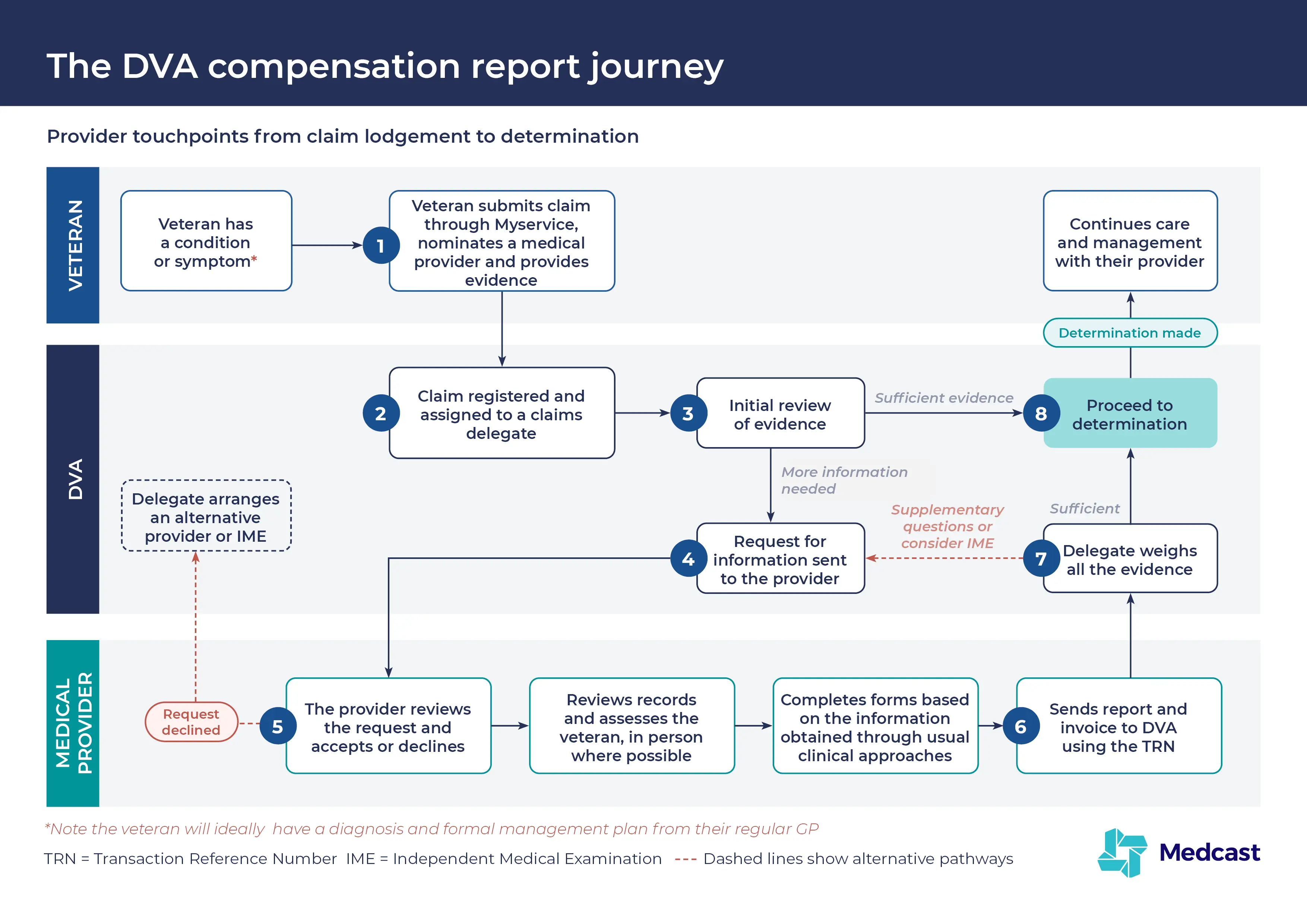
Overview of the veteran claims journey:
Step 1. The veteran lodges a claim.
Veterans submit claims for liability, permanent impairment or incapacity payments through the online portal MyService. At lodgement the veteran nominates a medical provider to complete any assessments, ideally their regular treating GP, defined by DVA as two or more face-to-face visits in the past 24 months (one visit for remote practices), and attaches any medical evidence they hold.
Step 2. Registration and delegate assignment.
The claim is registered and assigned to a claims delegate. Delegates make decisions under the legislation governing veteran compensation, including the Repatriation Medical Authority's Statements of Principles (SOPs). Since 1 July 2026, all new claims are determined under a single scheme, an improved Military Rehabilitation and Compensation Act, introduced by the VETS Act, regardless of when the veteran served. Importantly, delegates are not medically trained, which is why clear, factual medical information is required from the medical provider.
Step 3. Initial review of evidence.
This is the first decision point. The delegate reviews the evidence already on file, including the medical record that was used when the veteran was serving in the ADF. If the evidence is sufficient to make a decision, the claim can be determined without involving a medical provider. If not, the delegate sends a Request for Information to the nominated provider.
Step 4. The Request for Information.
The request letter sets out exactly what is needed: the forms to complete, a Provider Acknowledgement form covering the doctor–patient relationship and any use of telehealth or AI, and a Transaction Reference Number (TRN) for invoicing.
|
Review the request when it arrives. If the medical provider feels unable to complete it, the delegate can be notified using the contact details provided in the request. The delegate will arrange an alternative provider or an independent medical examination (IME).
Step 5. The assessment.
Most assessments can be completed from existing records, the GPs working knowledge of the patient, and an in-person consultation. Physical examination findings support diagnoses and are required for many impairment forms. Complete every question to usual clinical standards. The completing provider does not need to reference the DVA legislation or SOPs, and medicolegal reporting is not required.
For liability, provide a specific diagnosis, onset dates and a causation opinion to the best of your knowledge. Please also attach relevant investigation reports with a Patient Health Summary.
For permanent impairment assessments, complete all Medical Impairment Assessment forms requested by DVA. Key factors to consider when completing these forms are describing the veteran's usual level of impairment (rather than isolated episodes), indicate if the impairment is permanent and stable (identifying any treatment already undertaken or planned), and ensure any apportionment tables add to 100%.
Step 6. Submission & Invoicing.
Upload the completed assessment and an itemised invoice to the DVA Provider Upload Page using the TRN. Provider payment is based on consultation time, provision of notes and the number of pages completed, and will be made within 30 days of invoice submission.
Fee notes for GPs can be found here.
Step 7. The delegate weighs the evidence.
The delegate takes all the information into account, including the compensation assessment. Where evidence is sufficient, the delegate will finalise the claim for submission to the DVA.
If further information or clarification is required, then the GP may be contacted with a supplementary request. In some circumstances, the delegate may arrange for the veteran to undergo an independent medical examination (IME).
Step 8. Ongoing care.
Accepted liability opens access to funded treatment through Veteran Cards, and to compensation for permanent impairment and lost income. Regardless of the claim outcome, the veteran remains under the care of their GP.
At every stage of the journey, the quality of the medical information determines how quickly a claim moves. A specific, justified and complete assessment, prepared to the clinical standards Australian GPs already work to, enables veteran patients to receive the treatment and compensation to which they are entitled.
Resources.
Fee notes for GPs and specialists | Department of Veterans' Affairs

Dr Nazha Nazeem is a Melbourne-based General Practitioner with a dynamic footprint in medical education, particularly supporting International Medical Graduates transitioning into Australian General Practice. She completed the Doctor of Medicine from the University of Melbourne and has Fellowship with the Royal Australian College of General Practitioners (FRACGP). She is a Medcial Educator with the Remote Vocational Training Scheme (RVTS) where she supports registrars through fellowship exams.
Dr Nazeem is dedicated to designing learner-centred, practical educational programs, ensuring that training is relevant, supportive, and that it translates into effective, real-world practice.
Become a member and get unlimited access to 100s of hours of premium education.
Learn moreDr Rebecca Chan

GPs play a central role in cancer survivorship care. This practical guide explores coordinated shared care, recurrence monitoring, long-term and late treatment effects, chronic disease management, psychological wellbeing, preventive health and clear pathways for specialist referral.
Dr Rebecca Chan
Learn how GPs can provide culturally safe, inclusive cancer survivorship care for Aboriginal and Torres Strait Islander, rural and remote, LGBTIQA+, and culturally and linguistically diverse patients. Explore practical strategies to reduce barriers, improve engagement and support equitable outcomes.
Quality Use of Medicines Alliance

An evidence-based overview of perimenopause, covering common symptoms, diagnosis, lifestyle interventions, MHT prescribing principles and non-hormonal management strategies.