Living with and beyond cancer: the GPs role - clinical fact sheet and MCQ

Overview
Improvements in the early detection and treatment of cancer have increased survival rates and the number of Australians living with the long-term consequences of cancer and its treatment.
Up to two-thirds of people who are living with or beyond cancer report ongoing, unmet health care needs across physical, psychological and practical domains, highlighting the importance of coordinated follow-up care.
Although cancer survivorship is generally defined as the period from diagnosis to end of life, in shared care models it most commonly refers to the post-treatment phase, a time during which recurrence is more likely, and individuals may experience long-term and late effects of cancer and its treatments.
Traditionally, follow-up care has been specialist-led and focused on recurrence surveillance. However, growing numbers of Australians affected by cancer and the recognition of broader survivorship needs have driven a shift towards risk-stratified shared-care models that integrate specialist and primary care services. General practice plays a central role in this model, providing accessible, continuous and holistic care.
The role of the GP in post-treatment cancer care
This role is complex and includes:
coordination of ongoing medical care and care transitions between specialist and primary care services
monitoring for recurrence and facilitation of timely referral back to specialist services as needed
management of comorbidities and late treatment effects alongside cancer-specific issues
preventive healthcare including immunisation, screening and healthy lifestyle support
education about the role of regular exercise as a means of managing treatment-related side effects, supporting long-term health and reducing risk of cancer recurrence
supporting psychological wellbeing, including fear of recurrence and cancer-related distress
addressing practical concerns like return to work, relationships and financial stress
coordinating the involvement of allied health professionals, including exercise physiologists, physiotherapists, psychologists, dietitians and occupational therapists where appropriate, and
supporting patient self-management and health literacy
Living well with and beyond cancer requires chronic disease management
People living with and beyond cancer may be at increased risk of:
cardiovascular disease, type 2 diabetes and metabolic syndrome due to treatment effects and shared metabolic and lifestyle risk factors
osteoporosis, particularly following endocrine therapies such as aromatase inhibitors or androgen deprivation therapy
second primary cancers, and
long-term residual symptoms related to cancer treatment, eg cancer-related fatigue
Many people will also continue to experience fatigue, pain, neuropathy, cognitive changes, sexual health concerns or reduced functional capacity long after treatment has ended.
Despite their frequent contact with health services, evidence suggests that these patients often experience poorer management of their comorbidities compared to people without a history of cancer. This highlights the importance of ongoing GP involvement to ensure that both cancer-related issues and broader health needs are addressed through comprehensive chronic disease management.
Components of a comprehensive post-treatment review
The mnemonic CAREMAP may help provide a practical framework for structuring consultations and ensuring key domains of care are not overlooked.
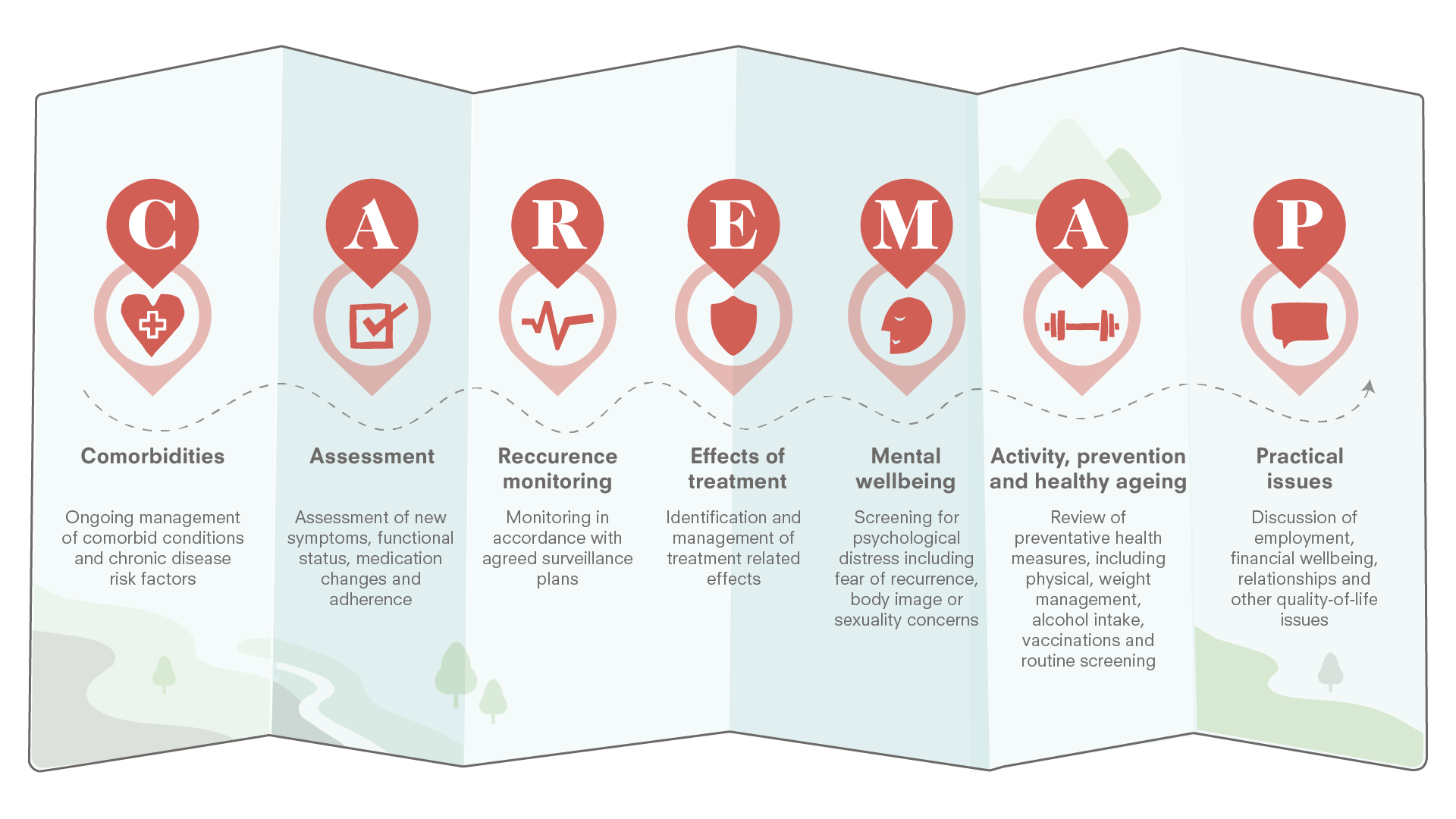
Comorbidities: ongoing management of comorbid conditions and chronic disease risk factors
Assessment: assessment of new symptoms, functional status, medication changes and adherence
Recurrence monitoring: monitoring in accordance with agreed surveillance plans
Effects of treatment: identification and management of treatment-related effects such as lymphoedema, menopausal symptoms, bone health, cardiotoxicity, neuropathy, cognitive change
Mental wellbeing: screening for psychological distress including fear of recurrence, body image or sexuality concerns
Activity, prevention and healthy ageing: review of preventative health measures, including physical activity, weight management, alcohol intake, vaccinations and routine screening
Practical issues: discussion of employment, financial wellbeing, relationships and other quality-of-life issues
Practical tips for shared care in post-cancer treatment
ensure you have an up-to-date treatment summary from the treating team outlining treatment received, likely late effects, recommended surveillance and red flags for re-referral
use My Health Record and other shared communication systems where available to support continuity of care and information sharing
clarify roles and responsibilities with both the patient and specialist including who is responsible for surveillance tests, follow-up appointments and ongoing management
establish clear pathways for rapid specialist review when recurrence is suspected or complex treatment-related issues arise
use longer or structured consultations including chronic care management plans or mental health care plans where appropriate to coordinate care and assist patients accessing allied health services
support patient self-management through education about late effects, healthy lifestyle behaviours, symptom monitoring and when to seek medical review
Red flags for referral
new or unexplained symptoms suggestive of recurrence or metastatic disease
significant, unresolved psychosocial distress
uncertainty about surveillance interpretation or next steps
complex or emerging late effects outside GP scope (e.g. progressive lymphoedema or suspected treatment-related cardiotoxicity)
Looking ahead
As the number of Australians living with and beyond cancer continues to grow, survivorship care is becoming an increasingly important component of healthcare delivery.
Contemporary Australian frameworks emphasise coordinated, person-centred and risk-stratified care delivered through effective partnerships between specialist and primary care services. Within these models, GPs are uniquely placed to coordinate care and support people to live well with and beyond cancer.
References
RACGP. Cancer survivorship shared care. 2024. Available at: https://www.racgp.org.au/FSDEDEV/media/documents/Advocacy/RACGP-Position-statement-Cancer-survivorship-May-2024.pdf.
Emery J. Cancer survivorship – the role of the GP. AFP. 2014; 43(8):521-525.
Vardy JL, Chan RJ, Koczwara B, et al. Clinical Oncology Society of Australia position statement on cancer survivorship care. AJGP. 2019; 48(12):833-836.
Clinical Oncology Society of Australia Model of Survivorship Care Working Group. Model of Survivorship Care: Critical Components of Cancer Survivorship Care in Australia Position Statement. Clinical Oncology Society of Australia. 2016. Available at: https://www.cosa.org.au/common/Uploaded%20files/Position%20Statements/cosa-model-of-survivorship-care-final-11072016.pdf.
Claim your CPD
After reading the clinical summary above and reviewing the references, complete the quiz to gain 30 minutes of EA CPD and 30 minutes of RP CPD.
You can either self-report CPD to your CPD home, or Medcast will track your learning via your personal CPD Tracker and you can download and report these points once a year. See our CPD Tracker FAQ.
Quiz
Please log in or sign up for a free Medcast account to access the case study questions and achieve the CPD credits.

Rebecca is a Sydney-based GP with a special interest in women’s health across the ages, including contraception, antenatal care, and menopause. Over the past ten years, she has worked across various general practices and specialised reproductive and sexual health settings. Alongside her clinical work, she is a medical educator with both the RACGP and Medcast, and has been actively involved in registrar education and training for the past five years.
Become a member and get unlimited access to 100s of hours of premium education.
Learn moreDr Rebecca Chan
As more Australians live longer with and after a cancer diagnosis, GPs play an increasingly important role in survivorship care. The new GP Cancer Care Hub brings together practical, evidence-based education and resources to help GPs support patients living with and beyond cancer in everyday general practice.
Dr Rebecca Chan
Learn how GPs can provide culturally safe, inclusive cancer survivorship care for Aboriginal and Torres Strait Islander, rural and remote, LGBTIQA+, and culturally and linguistically diverse patients. Explore practical strategies to reduce barriers, improve engagement and support equitable outcomes.
Compensation assessments are an important part of a veteran's DVA claim journey, yet for many GPs they remain unfamiliar territory. This article maps the journey from claim lodgement to determination, explaining each step and exactly where a GPs assessment fits in.