

Common pitfalls in DVA compensation assessments and how to avoid them
What is a DVA Medical Impairment Assessment?
A medical impairment assessment form is requested by the DVA after liability for a condition is accepted. The initial assessment of liability is completed using the Diagnostic Liability form. An impairment assessment aims to determine the impact of a veteran’s service-related condition(s) on their overall function. The medical impairment assessment forms are the instrument for collecting the necessary medical information. They ask for condition severity, functional status, a small number of examination findings, common investigation results, and previous and current treatment. The forms cover a wide range of body systems and conditions, encompassing both specific and general impacts.
Whilst forms may appear repetitive, each question addresses a legislative need. Incomplete forms are a common reason for delays in claims being assessed. To minimise additional assessments and processing delays:
do not leave questions or tables blank
answer every question as completely as possible
indicate when information is unavailable or cannot be determined
These forms are read by claims delegates. Delegates are not usually medically trained. They take the answers on the forms and apply them against a legislated impairment assessment guide to produce an impairment rating, which – together with the assessment of the impact on the veteran’s lifestyle – determines the compensation the veteran receives. A delegate generally cannot infer, interpolate, or read between the lines of a clinical narrative. If a box is empty, there is nothing to apply.
Completing the impairment assessment with sufficient detail will minimise the need for supplementary reports from a provider, and the need for independent assessment referrals for veterans. Avoiding the common misunderstandings, misconceptions, and assessment pitfalls below will help streamline the impairment assessment process for veterans and providers.
The following case has been created to explain the pitfalls.
Case study
A 61-year-old male veteran has the following accepted conditions:
lumbar spondylosis
right knee osteoarthritis
left ankle instability
fracture left clavicle
migraine
The veteran generally functions well, with limitations due to lower limb and back pathologies slowly progressing as he ages. However, the right knee condition is his current concern, and the main reason for walking pace reduction and limited distance, although this has not significantly interfered with participation in social activities. He is not disfigured and is not significantly limited.
His GP has received a request for medical impairment assessment forms. The case snapshot below summarises how the key questions were answered.
Accepted condition | Permanent? | Stable? | Comment |
Lumbar spondylosis | Yes | Yes | Degenerative and slowly progressive; no change in treatment or surgery pending |
Right knee osteoarthritis | Yes | No | A structured exercise program could improve function; review in 6 months |
Left ankle instability | Yes | Yes | Chronic instability; no further treatment expected to improve function |
Fracture left clavicle | No | Not applicable | Resolved, with no ongoing impairment |
Migraine | Yes | Yes | Established intermittent pattern; assessed on the Intermittent Condition(s) form |
Note: only the forms relevant to the pitfalls are discussed. The full suite of forms for this veteran (for example upper limb, knee, and ankle forms) is not covered in this resource.
Nine common pitfalls
Open a pitfall to see the fix and how it applies to the case.
Permanence
A condition’s impairment is generally considered permanent if it is expected to continue indefinitely, to at least some degree. This means that acute injuries that are expected to resolve are generally not considered permanent; for example, the fracture of the left clavicle in the case above.
Chronic, degenerative conditions would be considered permanent. Conditions that are ongoing, but in a period of clinical remission at the time of assessment – for example mental health conditions – are usually considered permanent for compensation purposes.
Similarly, conditions which only occur intermittently, such as epilepsy, can be considered permanent if the clinical pattern has been established. If a definitive treatment has been performed – total joint replacement for osteoarthritis, or chemotherapy with curative intent for malignancy – the underlying condition is still considered permanent as there has been a permanent pathophysiological change.
Stability
The clinical understanding of stability, that a condition or symptom does not fluctuate and is unlikely to change, is different to the DVA concept of stability for permanent impairment assessments, which is that a condition is unlikely to improve.
For impairment assessments, a degenerative condition that continues to progressively worsen is likely to be considered stable, unless a significant change in treatment is needed or surgical treatment is pending. Similarly, a condition with fluctuating impairment that is within the expected natural history of the condition, mood disturbances with mental health conditions, or episodes of asthma, is also likely to be considered stable.
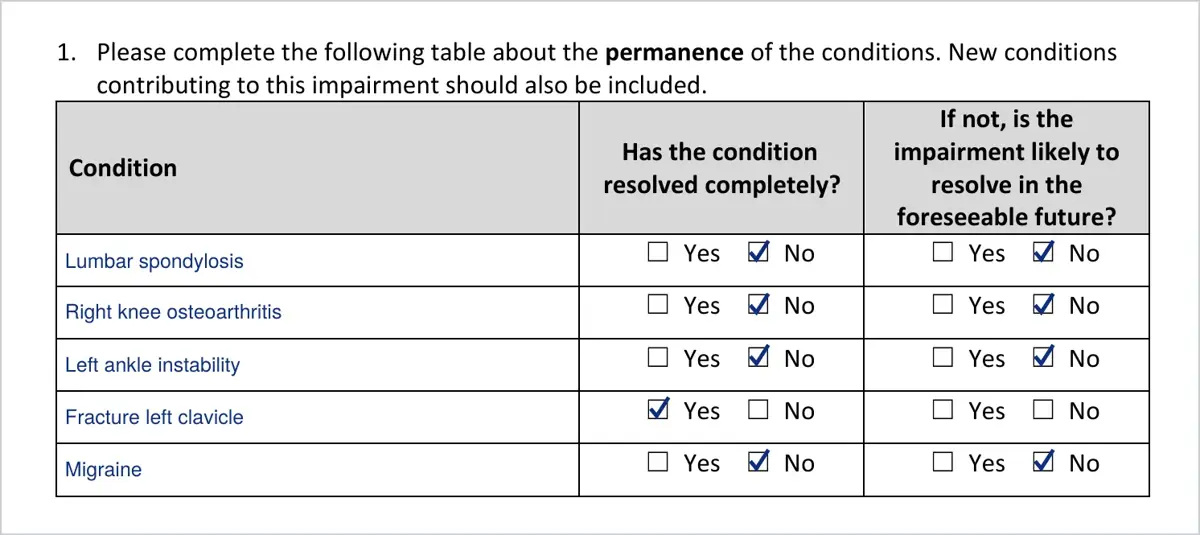
In the case Figure 1. The permanence table asks two questions per condition, and a row for every condition contributing to the impairment should be completed.
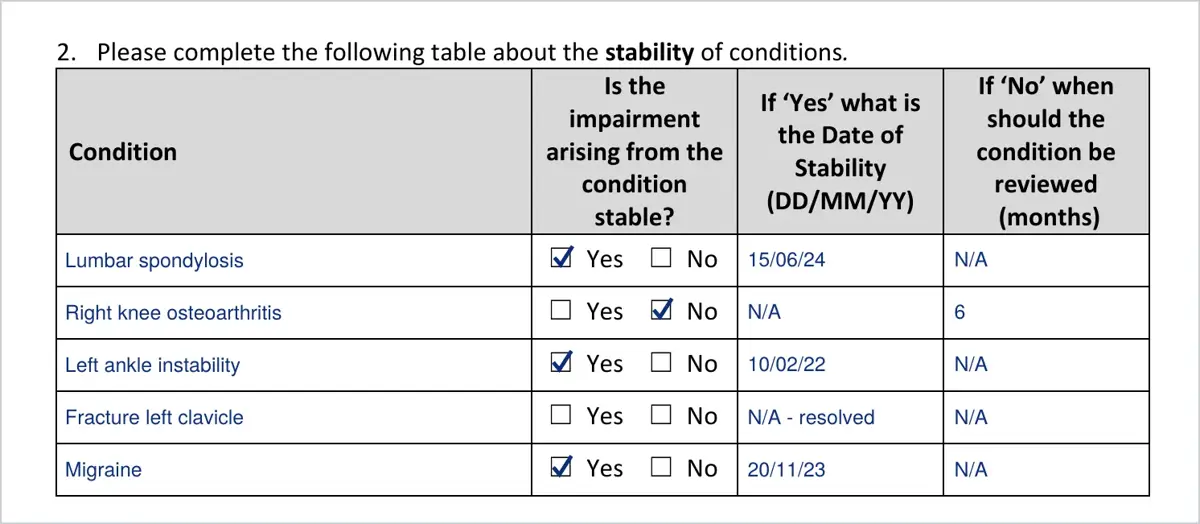
Figure 2. Where impairment is stable, a date of stability is required. Where it is not, give the interval at which it should be reviewed – an estimate is acceptable. Every accepted condition gets a row in the permanence table. Migraine is permanent even though it is intermittent, because the pattern is well established. The clavicle fracture has healed with no ongoing impairment, so it is recorded as not permanent, and its row is still completed. Lumbar spondylosis is slowly worsening with age but is stable in the DVA sense: no significant treatment change is needed and no surgery is pending. A date of stability is given. The right knee osteoarthritis is permanent but not stable, because further treatment is expected to improve it. The GP gives a review interval of 6 months instead of a date of stability. |
The pitfall |
Describing the veteran’s level of impairment should not occur isolated from considerations of treatment need and potential impact. If you are documenting a level of impairment that would usually be an indication for treatment and that treatment has not occurred, logically there would be a chance of improvement. If treatment is contraindicated or you do not think improvement is likely, a more detailed explanation is helpful.
Future treatments do not have to be actively planned. Providers should only include possible treatments and their expected benefit where this would be clinically appropriate for that veteran in the foreseeable future. Total joint replacement, for example, would not need to be included as a treatment consideration for a veteran with early knee osteoarthritis causing minimal functional losses.
Treatment that does not improve the veteran’s symptoms, function, or impairment does not need to be included on the form. This can include treatments aimed at preventing disease progression or complications.
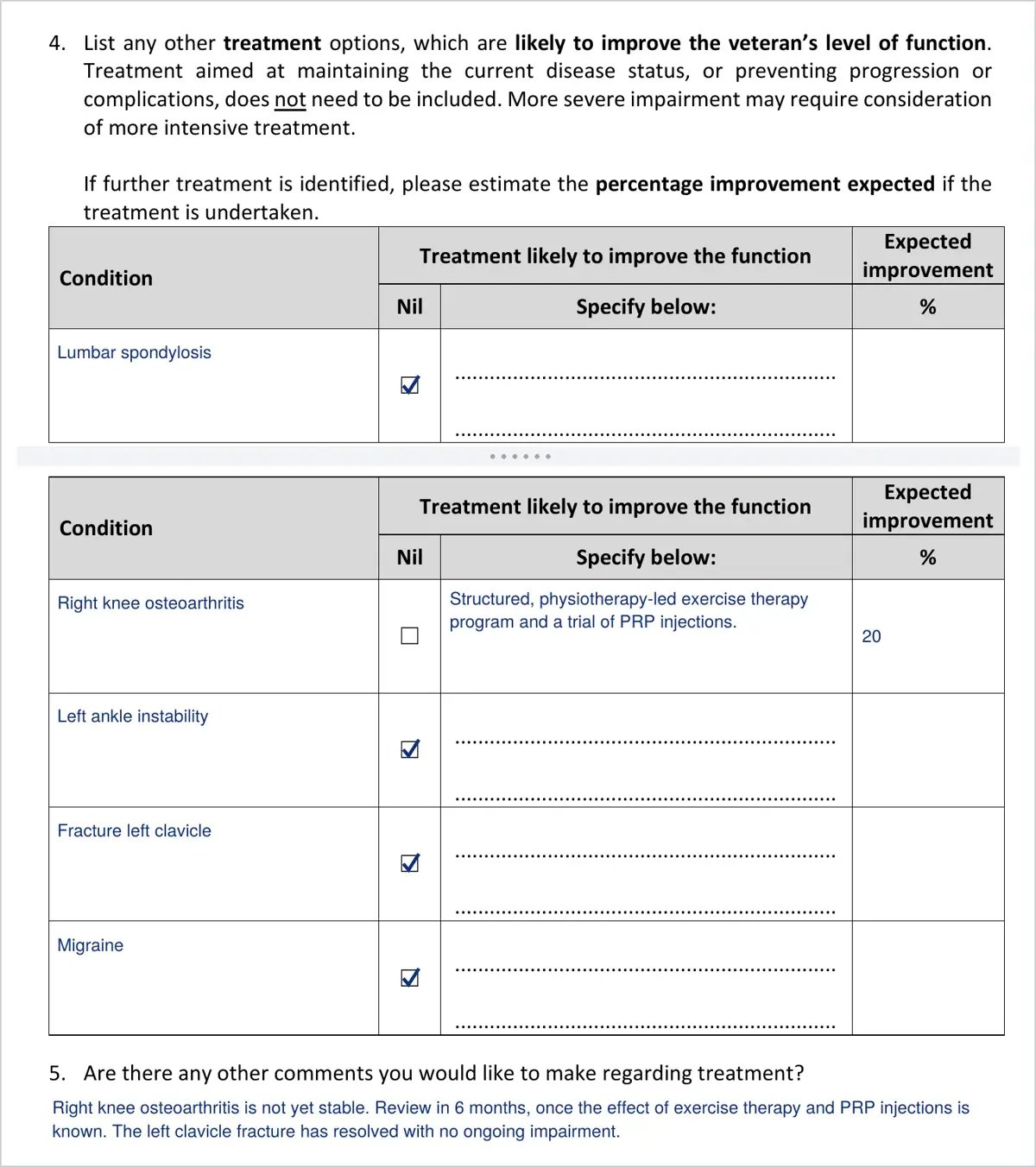
In the case For the lumbar spine and left ankle, no further treatment is expected to improve function, so ‘nil’ is entered. Knee replacement is not listed, because it is not a clinically appropriate consideration for him in the foreseeable future.
Figure 3. ‘Nil’ is a complete and legitimate answer where no further treatment would improve function. Where treatment is nominated, an estimated percentage improvement is expected. |
The pitfall |
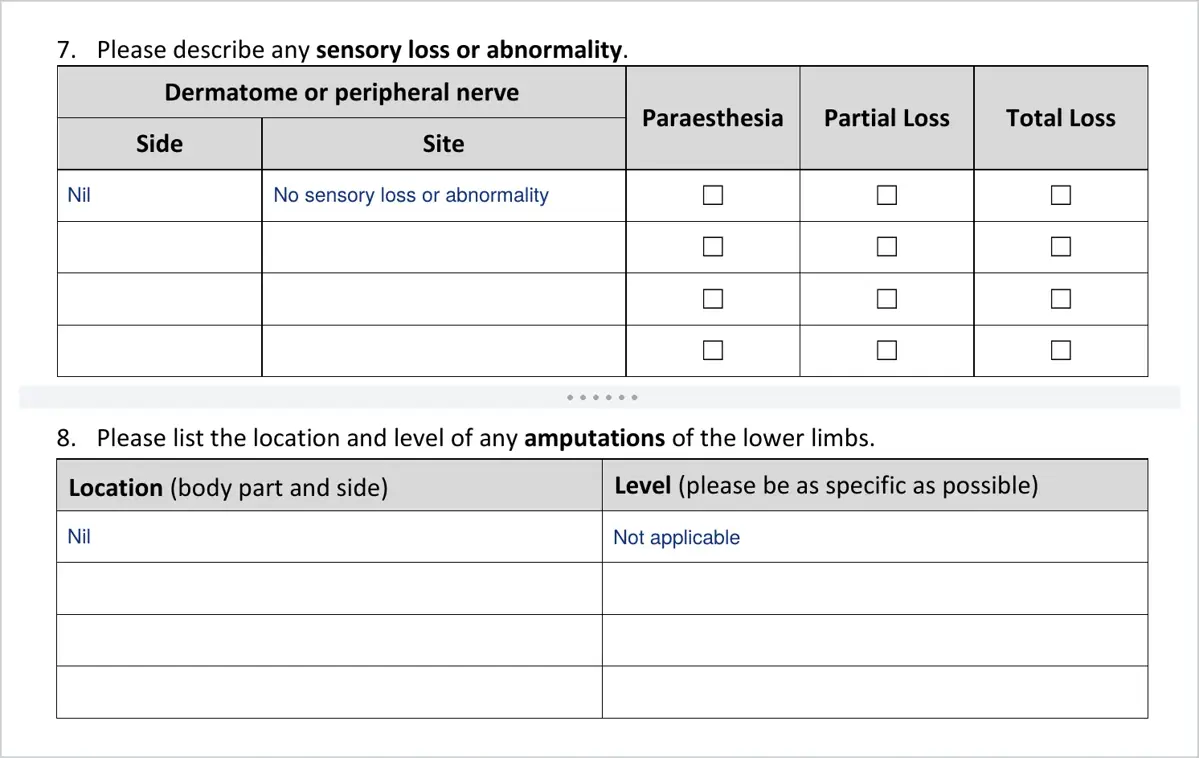
Incomplete, missing, or inaccurate information may lead to further assessment being requested. This can be in the form of a supplementary report or independent assessment, delaying the completion of the claim. Completion of all questions reduces the risk that information relevant to the claim is overlooked, which may inadvertently lead to the veteran missing out on compensation they were otherwise entitled to.
Providers should ensure that:
questions or tables in the forms are not left blank or crossed out
each field is completed – if you are unable to answer the question, indicate this on the form
Impairment assessments should describe the average level of impairment, or the impairment the veteran experiences on a typical day. Avoid describing the veteran’s level of impairment at their worst, such as during an acute flare.
Focusing on the veteran’s worst days may overstate their usual level of impairment and raise questions about whether sufficient treatment has been provided. For example, while an acute meniscal tear might temporarily limit walking to flat surfaces, it is unlikely that this would be the long-term impact without surgical consideration.
Similarly, reporting that a repaired ACL tear from 20 years ago limits walking to 50 m might raise questions about whether osteoarthritis has developed in the knee.
Some conditions with minimal baseline impact but significant occasional attacks (eg epilepsy or migraines) will be more appropriately assessed with the Intermittent Condition(s) Medical Impairment Assessment form (D9420). When relevant, the delegate will include this form in the request for information.
In the case
Figure 5. Single-select functional descriptors like this one are answered for a typical day – not for the worst day, and not for the best. |

Intermittent disorders are characterised by discrete episodes of impairment that are qualitatively or quantitatively different from the veteran’s usual level of functioning. These episodes are more than routine variations in symptoms and represent distinct periods of increased impairment.
When completing an intermittent disorder assessment, providers should:
describe the episode types experienced by the veteran, rather than listing the symptoms that occur during an episode
assess the frequency and severity of each episode type
For example, ‘migraine episode’ or ‘asthma exacerbation’ is generally more useful than listing symptoms such as headache, photophobia, shortness of breath, or cough.
Providers should ensure that their reporting of an intermittent condition reflects only the episodes of increased impairment, and not the baseline impairment, which is assessed elsewhere.
Download the Intermittent Condition(s) Medical Impairment Assessment form (D9420) from the DVA website.
The pitfall |
The reported level of impairment should correlate with the expected impact of the condition. Where the level or type of impairment is different to what may be clinically expected for the condition, DVA may seek further explanation to confirm the level of impairment, as well as the permanence and stability of the condition. This may take the form of a more detailed clinical history, treating specialist letters, or an independent assessment.
If the level of impairment is especially low, high, rapidly changing, or in some other way atypical, providers should consider whether other medical conditions are contributing to the impairment or whether further treatment is needed.
In the case |
The pitfall |
In general, most acute injuries and infections – sprains, strains, fractures, lacerations, viral and bacterial infections – will be resolved without ongoing functional impairment. Ongoing impairment may be clinically plausible in some circumstances; however, providers should consider whether the apparent chronic effects of an injury are better explained by an alternative diagnosis.
When a secondary condition develops, for example, OA of the knee following an historic ACL injury, it is more common for the new condition to be the cause of the impairment. Providers should be alert to this when the impairment from an acute injury is atypically long-lived or progresses after a period of stability.
In the case |
The pitfall |
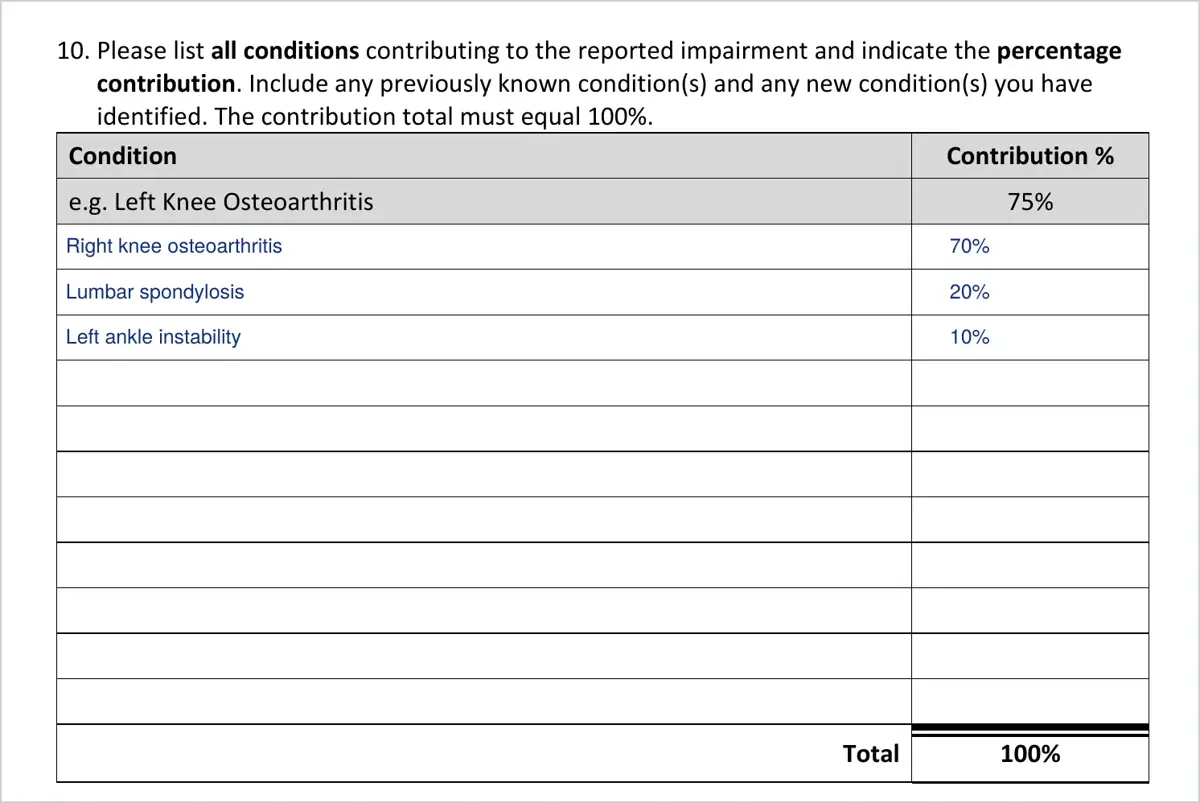
Apportionment involves identifying all conditions contributing to an impairment and estimating their contribution, as a percentage, to the overall impairment. All conditions that contribute to an impairment should be included in the apportionment tables. If it is likely that a new, as yet undiagnosed condition is contributing to an impairment, this should be indicated on the form.
If a condition has been listed in the table but is not contributing, it can be assessed as a 0% contribution. You do not need to add conditions that are not contributing and are not already in the list.
In the case
Figure 6. A completed apportionment table. Every condition contributing to the impairment is listed, and the column totals 100%. |
The pitfall |
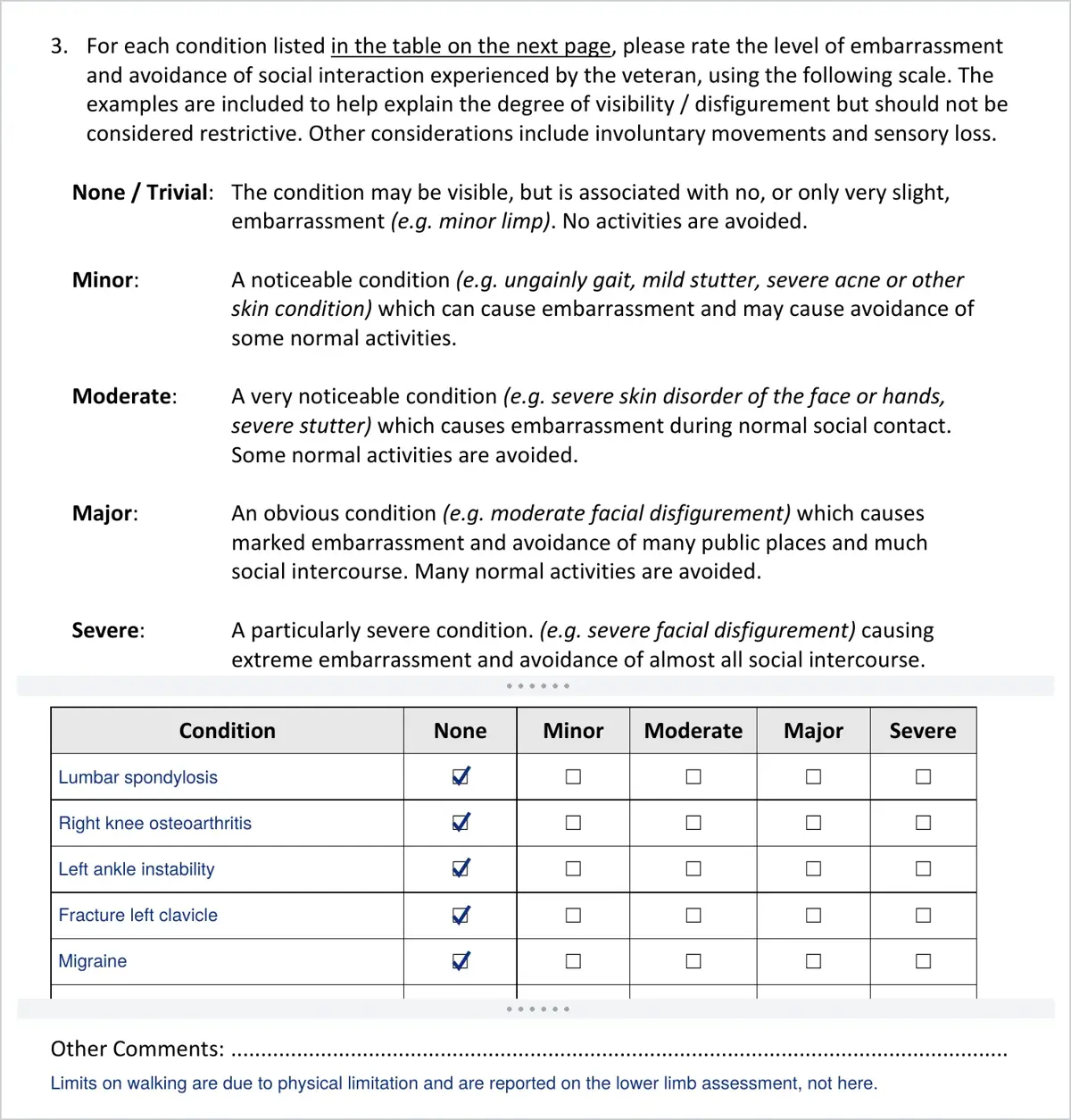
Assessment of disfigurement and social impairment relates to embarrassment experienced by the veteran, and the impact on social interaction, due to conditions that are noticeable or disfiguring. It is not used to represent the severity of the condition itself, which is assessed elsewhere.
This rating addresses the impact of avoiding activities and social interaction solely because of the embarrassment or social discomfort of others of a noticeable condition when in public. Do not include the impact in private or intimate situations.
Some veterans may not be able to engage in social activities because of the physical limitations of a condition, or because of anxiety of being in public. These impacts are captured elsewhere and should not be considered in this section of the form.
In the case
Figure 7. The rating descriptors are anchored to visibility and avoidance, not to pathology. A condition causing real functional limitation may rate ‘none/trivial’. |

Dr Nazha Nazeem is a Melbourne-based General Practitioner with a dynamic footprint in medical education, particularly supporting International Medical Graduates transitioning into Australian General Practice. She completed the Doctor of Medicine from the University of Melbourne and has Fellowship with the Royal Australian College of General Practitioners (FRACGP). She is a Medcial Educator with the Remote Vocational Training Scheme (RVTS) where she supports registrars through fellowship exams.
Dr Nazeem is dedicated to designing learner-centred, practical educational programs, ensuring that training is relevant, supportive, and that it translates into effective, real-world practice.
Become a member and get unlimited access to 100s of hours of premium education.
Learn moreDr Rebecca Chan

GPs play a central role in cancer survivorship care. This practical guide explores coordinated shared care, recurrence monitoring, long-term and late treatment effects, chronic disease management, psychological wellbeing, preventive health and clear pathways for specialist referral.
Dr Rebecca Chan
Learn how GPs can provide culturally safe, inclusive cancer survivorship care for Aboriginal and Torres Strait Islander, rural and remote, LGBTIQA+, and culturally and linguistically diverse patients. Explore practical strategies to reduce barriers, improve engagement and support equitable outcomes.
Compensation assessments are an important part of a veteran's DVA claim journey, yet for many GPs they remain unfamiliar territory. This article maps the journey from claim lodgement to determination, explaining each step and exactly where a GPs assessment fits in.